This is the personal blog of Ian Ker, who was Councillor for the South Ward of the Town of Vincent from 1995 to 2009. I have been a resident of this area since 1985. This blog was originally conceived as a way of letting residents of Vincent know what I have been doing and sharing thoughts on important issues. I can now use it to sound off about things that concern me.

If you want to contact me, my e-mail is still ian_ker@hotmail.com or post a comment on this blog.

To post a comment on this blog, select the individual post on which you wish to comment, by clicking on the title in the post or in the list to the left of the blog, and scroll down to the 'Post a Comment' box at the foot.

Search This Blog

Saturday, February 15, 2014

Et Tu Subi - What Has Subiaco Council Been Smoking?

I'm absolutely gobsmacked that, at this late stage and knowing the Subiaco community's strong support for retaining Subiaco, the Subi Council can make this sort of submission to the LGAB. By falling into the same trap as Vincent did initially of making a submission/proposal under duress, Subiaco Council is giving succour to the Government in its divide and conquer strategy. At the very least, Subiaco might have sought inclusion in either the Vincent or State Government proposal for Perth/Vincent rather than the divisive asset-stripping City of Perth proposal.


As a former City of Vincent Councillor (for 14 years) and WALGA zone representative for much of that time, I am aghast that one local government would involve itself in the affairs of another one in this way. How would Subiaco feel if Vincent had said that City of Perth should take over part of Subiaco.

By the way, I note from the Subiaco Council Minutes that Crs Trinder, Stroud, Clements and Potter voted against this  part of the motion and I commend them for doing so.

And as for Lisa Scaffidi's comment about density - the average residential density of Vincent is only slightly less than that of Vincent. Is she aiming to cherry-pick parts of Subiaco, too?

In practice, it probably doesn't make a lot of difference, since the LGAB can't recommend something substantially different from proposals it is already considering without starting the whole process over again. 

Also, as I have previously noted, the LGAB can't recommend the City of Perth proposal, anyway, as it leaves the remainder of Vincent in unviable limbo.

Friday, February 14, 2014

Lisa Really Doesn't Have a Clue

Perth Voice, 15th February, 2014. Click to enlarge.
Lisa Scaffidi still hasn't twigged to the fact that the Local Government Advisory Board can't recommend the City of Perth's proposal to asset-strip the City of Vincent.

One might hope that the LGAB would not recommend the CoP asset-grab on economic, governance, equity or even moral grounds - but even failing all that, the proposal leaves the rest of Vincent in limbo.

I'm not sure that Eleni Evangel gets it, either. The issue of interim governance is not simply decisions that are made on development applications during that time - it is more about the governance structures (including wards) and the culture that will start to take root.

The only fair way to implement amalgamation is to have a complete spill of elected member positions so that the new entity can be genuinely representative of its community  - and, yes, that does mean one-vote, one value. In the interim period, some form of representation that does not disenfranchise one community (Vincent) to the benefit of the other (Perth) has to be found.

Why Government's Amalgamation Proposals Are Invalid

In a recent post on this blog ('Nonsense Proposals and How To Respond'), I stated that "the two proposals from the State Government (Perth/Vincent and Bayswater/Bassendean) do not meet the requirement of the Local Government Act to "set out clearly…the effects of the proposals on local governments".

It has been suggested to me, in the context of otherwise supportive comments on this blog, that the Government's proposals might be 'threadbare' but would meet the requirements of the Act.

So here is my reasoning for stating that the Government's proposals do not meet the requirements of the Act and would therefore be open to successful challenge in the courts.

In the absence of a definition of the term in the Local Government Act, 1995, the first resort would be to the Interpretation Act, 1984  (http://www.austlii.edu.au/au/legis/wa/consol_act/ia1984191), section 5 of which contains standard definitions for written laws of Western Australia. However, this does not include a definition of the word 'effect(s)'.

In the absence of such a definition, the next resort would be to the Second Reading speech of the appropriate Minister when the Bill was debated by Parliament prior to its being passed into an Act. I must admit I haven't been back and checked this, but I would be very surprised if it dealt with a matter of such detail.

Finally, the issue then comes down to 'common usage' - the 'prevailing and accepted interpretation'. Common usage would be along the lines of 'a change which is a result or consequence of an action or other cause' - the Government proposals for amalgamations are almost entirely a description of the 'action or other cause' itself. 

To the extent that there is any statement of effect, it is contained in just two paragraphs under the heading 'Reason for Making the Proposal'. 

The first of these paragraphs is almost word for word the same in all proposals (not just those affecting Vincent) and therefore provides no information specific to the effects of any individual proposal. In any case, statements made are no more than unsubstantiated assertions of potential - the word 'opportunity' keeps cropping up - rather than real and demonstrable effects.

The second paragraph is a combination of description of the action and broad assertion of aspiration - again unsullied by any analysis or real-world support. 

From Vincent's perspective, it is critical that this second paragraph fails to mention Vincent at all. The statements, other than the purely descriptive first sentence, are all about the City of Perth. The proposal clearly fails to identify 'effects' on the City of Vincent, its residents and ratepayers.

Irresponsible NOT to Have Figures, Minister

Click to enlarge
Local Government Minister, Tony (Homer) Simpson, says it's irresponsible to "bandy figures around" on the cost of local government amalgamations.

How much more irresponsible is it to force amalgamations without any idea what they will cost - or, come to that, what the benefits will be.

Or, if the Government does actually have cost and benefit estimates, how irresponsible is it not to show them to those affected. The Government's proposals to the Local Government Advisory Board are almost laughably brief, with only two paragraphs of generalisations and unsupported claims on the effects on local governments.

The Government is asking us to buy the proverbial pig in a poke. The taxpayer or ratepayer will have to pick up the tab for amalgamations with no knowledge of what the benefits will be - or even if there will be any net benefits.

I'm not going to 'bandy figures around' - although the Cockburn figures do come from a reputable source - but I can vouch, from personal experience, for the difficulty and disruption of local government reorganisations. In 1964/5, between leaving school and going to university, I had a job with the London Borough of Ealing - this was at the time the Greater London Council was being created. Ealing was a merger between one existing local government and parts of two others (this will sound familiar to the people of Cockburn) and I can tell you that, however serenely swan-like it might have appeared on the surface, beneath the water was, like the swan, chaos.

Saturday, February 8, 2014

Subiaco - Most want to stay Subi - Divided views on alternatives

Even with the semantics being used by the WA Government to try to avoid the Dadour poll provisions of the Local Government Act, it has found no way of avoiding a poll in the Western Suburbs - the so-called G7 proposal.

It is ironic, in the extreme, that the area that has commonly been the focus of discussions of the need for local government amalgamations might be the only one where residents and ratepayers actually get the opportunity to reject the proposals. And if the City of Subiaco's survey is any guide, the proposals will be defeated.

The City of Subiaco carried out a phone survey of residents and ratepayers late last year. This clearly showed strong preference for keeping Subiaco as it is but, equally important, showed the lack of consensus support for any of the possible alternatives.
Although business owners were more likely to support change, there were still more of them against the Government's G7 proposal than supporting it.

Wednesday, February 5, 2014

Pre-Empting the Local Government Advisory Board?

Or is the whole LGAB process just a sham/smokescreen?

The previously-announced timelines for the amalgamation process had the LGAB finishing its inquiry process in June 2014 (and that will be a tough timeline to meet, given the number and complexity of proposals), the Minister for Local Government considering those proposals in July 2014 and the Governor issuing orders for new local governments in August 2014.

Now, the Government, with the connivance of WA Local Government Association and the Local Government Managers Association, has issued a 'Local Government Reform Toolkit', which, amongst other things, requires "recommendations to be submitted to the LGAB relating to the Wards and Consequential directions of the Governors Orders" as soon as possible, but in any case before July 2014.

So local governments are being required to make proposals for matters such as ward structures at best at the same time as the LGAB makes its recommendations and certainly before the Minister has made a determination on those recommendations. This is clearly non-sensical and, at best, will involve a lot of wasted effort where there are conflicting proposals.

One of the principles set out in the toolkit is that "communities and stakeholders actively participate in the change process". How on earth are local governments supposed to consult meaningfully with their communities on matters of detail, such as ward structures, when they don't even know what their future configuration as local governments is going to be.

Nonsense Proposals and How To Respond

It's worth taking a close look at the five proposals that potentially affect the City of Vincent.

The two proposals from the State Government (Perth/Vincent and Bayswater/Bassendean) do not meet the requirement of the Local Government Act to "set out clearly…the effects of the proposal on local governments". The proposals are no more than a one-and-a-half page description of boundary changes with only two paragraphs of broad assertions of effects unsupported by any analysis.

The Local Government Advisory Board cannot recommend either of these proposals because they do not comply with the requirements of the Local Government Act. If the LGAB does recommend them, the decision will be open to (almost certainly successful) challenge in the courts.

The City of Perth proposal also cannot be recommended by the LGAB, as it would leave the remainder of Vincent (with the possible exception of the riverside area of Banks Precinct that would go to Bayswater/Bassendean under the WA Government and City of Bayswater proposals) as an unviable local government.

There is no current proposal for the remainder of Vincent to be amalgamated with any other local government.

If the LGAB were to consider that some other proposal for the remainder of Vincent should be considered (as would be required by its recommending the City of Perth proposal), the Local Government Act (Schedule 2.1, para 4, sub-para 3) effectively requires that the process be started anew.

The City of Bayswater proposal, that would annex the riverside area of Banks Precinct, should not be supported partly because its arguments with respect to the Banks Precinct (eg 'proximity' to Morley centre) are erroneous but, crucially, because there was no consultation (or even communication) with either the City of Vincent or the residents of Banks Precinct during the development of the proposal. 

The City of Vincent proposal also should not be supported because:

Click to enlarge
a)      It was made under duress after the WA Government released its initial proposals in July 2013 and stated that it would only consider minor variations from those proposals. The extent of variations since made by the WA Government, for a variety of reasons, clearly invalidates any responses made.
b)   The City of Vincent has, in the light of (a), above, and responding to community views, modified its position (5th November 2013) to be, first and foremost, in favour of retaining Vincent as a separate entity.

The only possible response to these proposals is to argue for rejection of all five. But we need to be careful in doing so that we also state a clear and unambiguous preference for Vincent to remain as it is - supporting the expressed community view and the most recent Council position on the matter. If retaining Vincent is not achievable, then the City of Vincent's proposal is the next best option.

If All Else Fails, Fall Back on Semantics

Having failed to get their proposal to remove the Dadour amendment from the Local Government Act through their own party room, Col Pot and Homer Simpson resort to obscure and bizarre interpretation of the language of the amendment.

By describing many of the proposed changes as 'adjustment of boundaries', they intend to remove the right of affected communities to have a say on the proposals.

How petty can you get!

I wonder how the people of Cockburn feel, for example. Two of three proposals affecting them (Fremantle/East Fremantle and Melville) are described as 'decreasing the size of the City of Cockburn' and the third (Kwinana/Cockburn) as 'disestablishing the City of Cockburn'. The fact that this is purely semantics is obvious from the fact that if the disestablishment had been attached to the Fremantle/East Fremantle proposal, the Dadour poll provision would still be in play.

And what about Perth/Vincent - described as 'increasing the size of the City of Perth'? Semantics again - what if we decided to call the new entity something other than Perth?

But to call it a boundary adjustment to the City of Perth is really stretching credulity and surely must be tested in the courts. Vincent is larger than Perth (11.4km2 compared to 8.7km2), has more people (31,500 compared to 19,000 - in 2011) and nearly twice as many electors (19,300 compared to 10,500 in 2009). The City of Perth does have three times the rate revenue (and total revenue), but dollars are not everything.

The sensible thing to do, if the proposal were to go ahead, would be to have a merger of equals by abolishing both existing entities and creating a new entity - even if it were still to be called the City of Perth.

Even more fundamentally, the Government proposal documents are totally inadequate to meet the Local Government Act requirement to "set out clearly…the effects of the proposal on local governments". The proposals are no more than a description of boundary changes and two paragraphs of broad assertions unsupported by any analysis.

Bottom line - the Local Government Advisory Board cannot recommend the WA Government proposals because they do not comply with the requirements of the Act.

Monday, February 3, 2014

Redundant Legislation

On 30th November 2013, the Minister for Local Government, Tony Simpson, introduced the Local Government Amendment Bill into the Legislative Assembly. 

On 3rd and 5th December, the Bill was debated by the Assembly.

On 10th December, the Bill was introduced into the Legislative Council, which has not yet completed its deliberations.

A key part of this Bill was the removal, temporarily (ie for the current local Council amalgamation process being promoted by the Government), of the requirement for the Local Government Advisory Board (LGAB) to call for submissions on amalgamation proposals.

On 29th January 2014, the LGAB called for submissions on 32 proposals it had received for changes to metropolitan local governments.

Will the Minister for Local Government now withdraw this provision (paragraph 14 of the Local Government Amendment Bill), as it is clearly redundant and it would be a waste of parliamentary time to continue to debate it?

Thursday, January 30, 2014

It's Time

At long last, the Local Government Advisory Board has issued the call for submissions on proposals for local government boundary changes. Whatever one thinks of the process to-date, at least the LGAB is doing the right thing in 
(a) calling for submissions rather than wait for the Bill that would remove that requirement to be passed by the Parliament (by no means guaranteed) and 
(b) doing so for all proposals, not just those made by the WA Government.

I don't envy the LGAB its task in assessing these proposals as there are so many conflicts between them.

But now is the time for all of us affected to let the LGAB know how we feel. The Board is required to consider all submissions and to have regard to:
- community of interest
- physical and topographical features
- demographic trends
- economic factors
- the history of the area
- transport and communications
- matters affecting the viability of local governments
- the effective delivery of local government services.


There is an information paper available from the Department of Local Government's website (http://dlg.wa.gov.au/Content/LG/AdvisoryBoard/CurrentInquiries/Downloads/LGAB_InformationPaper.pdf) but it does little more than outline the matters the Board must have regard to. 

There are FIVE proposals that affect the City of Vincent. These are:
- Proposal 16: The City of Vincent proposal for all of Vincent to join City of Perth
- Proposal 14: The City of Perth proposal for Perth to take over the southern part of Vincent (including Leederville centre and key assets)
- Proposal 01/2013: The State Government proposal for most of Vincent to join the City of Perth (but not the riverside Banks Precinct area)
- Proposal 6: The City of Bayswater proposal that would take over the riverside area of Banks Precinct
- Proposal 03/2013:The State Government proposal for Bayswater/Bassendean, which would also see the riverside area of Banks Precinct removed from Vincent.

You can find details of these proposals by scrolling down to the bottom of the web page (http://dlg.wa.gov.au/Content/LG/AdvisoryBoard/CurrentInquiries/MetroInquiries.aspx) and selecting 'Vincent, City of' from the drop-down menu.

I encourage all those who can to make submissions on all five proposals. You don't have to comment on the whole proposal, but it is important to have as many submissions as we can on those aspects that affect Vincent.

If you want Vincent to remain as an independent local government, you should say so clearly in your submissions - if you do not, you will simply be recorded as objecting to the current proposals, but there is no specific proposal for you to support.

To make a submission you can:
- complete the form attached to the information paper - this is a very basic form, so you would almost certainly need to add attachments
- write to the Local Government Advisory Board,c/- GPO Box R1250, Perth WA 6844
- email: advisory.board@dlgc.wa.gov.au
- fax: (08) 6552 1555

The submission period closes at 4pm on 13th March.

Friday, January 24, 2014

Threat to Vincent's Heritage

The City of Vincent doesn't allow demolitions unless there is a development approval for the property.

The City of Perth does allow demolitions with no development approval - and does so simply for the convenience of the property owner.

City of Perth has approved demolition of the Michelides Building on Roe Street, simply so that the owner can use the site as a storage and car parking site for renovation of an adjoining property - with no guarantee of acceptable redevelopment afterwards. Indeed, the owner will have the City of Perth over the proverbial barrel to subsequently approve any development (good, bad or indifferent) or be faced with a vacant block there for an indefinite period.

Mind you, Cr Rob Butler appears to think that a vacant site is better "in the context of the orderly and proper planning and the wider amenity of the area" than retaining at least the key elements of the existing building.

B*****ks, Rob.

Yet another reason for opposing the Barnett/Simpson proposed amalgamation of (most of) Vincent and the City of Perth.

Friday, January 3, 2014

What Did We Learn in 2013?

It's to be hoped that collectively we did learn something from 2013 or we shall fall into the trap enunciated by George Santayana: those who cannot learn from history are doomed to repeat it.

The overwhelming lesson from 2013 in WA is that our senior state politicians either can't be trusted or are incompetent.

We had Colin Barnett making all sorts of promises in the election campaign and then stating unashamedly that promises didn't matter because people didn't read the detail.

Specifically, he stated before the election that there would be no forced local government amalgamations under a Liberal government - then just a few months later he announced proposals aimed at exactly that. As part of that, he said he was going to remove the Dadour amendment to the Local Government Act, which allowed electors to call for a binding poll on amalgamation proposals - fortunately, he couldn't even get that through his own party room.

Then he introduced a Bill into the Parliament that would have removed the requirement for the Local Government Advisory Board to seek public submissions for at least six weeks on amalgamation proposals. This Bill hasn't yet passed the Upper House and the LGAB has stated that it will seek submissions on all proposals in late January.

And where was the Labor Party in all this? Covertly supporting Colin Barnett, that's where. There has been a deafening silence from David Templeman and other Labor figures on the whole farago, although in the debate on the Local Government Amendment Bill he did say that:
"…there has been an abuse of trust. There has been an abuse across the sector. The government told things to certain sections of the sector, changed its mind, rethought things and backflipped, which has undermined trust. That is where the government has fallen down most spectacularly. The government has failed to keep the trust of the very local governments it needs assistance from in this reform process, many of which have been willing participants, including South Perth, Victoria Park and Cockburn. They were willing participants in the reform process and recognised the need for reform. The government failed to keep their trust because it changes its mind constantly. The Local Government Amendment Bill 2013 is an example of that. That trust has been abused and therefore those local governments are very uncertain about where this whole process will lead and the future of their council, their ratepayers and their council employees."

Outside of this, though, the ALP appears to have been conspicuously absent from the debate and it has been up to the community and a few local governments to seek to keep Colin Barnett (Col Pot) and Tony (Homer) Simpson accountable, if not honest.

Saturday, December 21, 2013

Get Your Thoughts Together

The Local Government Advisory Board has stated that it will issue the call for submissions on Metropolitan local government changes 'in late January, 2014'. Whilst the Board will be issuing an Information Paper to assist people to make submissions, I'd suggest we all start thinking about what we want to say now, rather than waiting. This will be especially important if you're going to be making a submission on behalf of an organisation and need to get agreement from a number of peopl.

Quiet Time

It's been a bit of a quiet time in local government amalgamation land (and, frankly, I needed a bit of a break from it), with the slow progress (not yet complete) of the Local Government Amendment Bill through the WA Parliament - punctuated only by the presentation of a petition by the Dadour Group. Thanks to Adele Farina, MLC, for presenting this petition to the Legislative Council.

The petition refers to the provision in the Amendment Bill to remove, for the time being and for metropolitan local government only, the requirement for the Local Government Advisory Board to call for public submissions for at least six weeks on any proposal presented to it. It's good to see that, rather than wait for the outcome of the Bill, the Local Government Advisory Board has stated that it will abide by the current process for all of the proposals currently before it.

It's a pity that the submission period is likely to be over the Christmas/New Year silly season (a well-tried tactic of governments when consulting on controversial issues), but the onus is now on all of us who oppose specific proposals and/or the process by which they have been arrived at to put down in writing that we do so object and why.

The Board is required to consider all submissions and to have regard to:
- community of interest
- physical and topographical features
- demographic trends
- economic factors
- the history of the area
- transport and communications
- matters affecting the viability of local governments
- the effective delivery of local government services.

So the opportunity is there to make the Board fully (even painfully) aware of the strength of feeling about these largely ill-considered, and sometimes contradictory proposals. The eight points above provide a template for expressing your views.

I can see people having a field day in respect of community of interest (or, rather, lack thereof) for many of the proposed changes.

Friday, December 13, 2013

Dirty Tricks?


Click to enlarge
And I'm not referring to the West Australian's 'downgrading' of City of Vincent Mayor, John Carey, by the lack of an initial upper case letter. Perhaps the sub-editor thought that capital letters are reserved for capital city office-bearers.

And Yolanda Zaw still hasn't caught up with the fact that the revised State Government proposals, as submitted to the Local Government Advisory Board, do not place the whole of the City of Vincent into an enlarged City of Perth - as noted previously in this blog (http://ianrker-vincent.blogspot.com.au/2013/11/premiers-porky-wheres-logic-or-fairness.html), the riverside area of Banks Precinct is excluded.

I recall that not so long ago, Premier Colin Barnett was encouraging the City of Perth and the City of Vincent to work together on amalgamation. Now we have the City of Perth going it alone with surveys of Vincent residents - presumably so that it can massage the results in a way that suits it.

At the very least, I hope that the City of Perth publishes a full report on its survey - including how the survey was set up, the preamble to respondents, questions asked, response rates and any other issues that might have influenced the results. As I know from professional experience with many surveys (not to mention the 'Leading Questions' lesson from 'Yes, Prime Minister'), surveys can be slanted (consciously or subconsciously) to give whatever answer is sought.


Here's a thought, too. Is City of Perth in breach of Section 3.20 of the Local Government Act, which relates to the performing of functions outside its area without the consent of the local government responsible for the area. This section is primarily to do with physical works, but the principle would seem to apply equally to non-physical works such as surveys.

Thursday, December 5, 2013

Making Things Happen

Congratulations to the City of Vincent for taking the bold step of engaging placemakers for its four urban village centres. This is a first for Perth and will be much-needed to counterbalance the CBD-focus of the City of Perth if Vincent should be swallowed up in the Col Pot masterplan for local government.

When I helped organise the Mainstreet Conference in 2009 (held in Fremantle and supported by the City of Vincent), I was struck by the importance of place and how easily it can be overlooked in the normal processes of government.

At the state level, there is a lot of talk of activity centres and urban villages - but nothing to make them happen or to enhance and maintain their vitality and viability.

This step is a classic example of what small local governments can do that would be very difficult for larger ones. Vincent can do this for all four of its centres but a larger local government would have to deal with competing demands from across its area.

Monday, December 2, 2013

Intelligence and Functioning

F Scott Fitzgerald wrote, in The Crack Up, a collection of essays, notes and letters, that the test of a first-rate intelligence is the ability to hold opposed ideas in the mind at the same time and still retain the ability to function.

Alas, we currently have a collection of federal and state politicians who can hold opposed ideas but without retaining the ability to function.

One look at the WA shenanigans over the attempts to remove democratic provisions in the forced local government saga, shows that both Barnett and Simpson hold opposed ideas on democracy and local government.

At the federal level, Tony Abbott and Chris Pyne clearly hold opposed ideas on truth and government, in bare-faced denial even when faced with documented evidence of what they have said.

The pity of it is that none of these gentlemen (and I use the term with more than a hint of sarcasm) retains the ability to function - and that costs all of us dearly.

Lies and Fans

Found in the on-line comments on a Guardian article on Abbott/Pyne and Gonski. Might I suggest that Colin Barnett's clock would make a good back-up ceiling fan.
A man died and went to Heaven. As he stood in front of the Pearly Gates, he saw a huge wall of clocks behind him. He asked, "What are all those clocks?"
St Peter answered, "Those are Lie-Clocks. Everyone who has ever been on earth has a Lie-Clock. Every time you lie, the hands on your clock move."
"Oh," said the man. "Whose clock is that?"
"That’s Mother Teresa’s," replied St. Peter. "The hands have never moved, indicating that she never told a lie."
"Incredible," said the man. "And whose clock is that one?"
St Peter responded, "That’s Abraham Lincoln’s clock. The hands have moved twice, telling us that Abraham told only two lies in his entire life."
"Where’s Tony Abbott’s clock?" asked the man.
St Peter replied, "We are using it it as a ceiling fan."

Sunday, December 1, 2013

Let The Chaos Continue

Subiaco Post, 30th November 2013.
The Subiaco situation highlights and exemplifies the chaos surrounding the local government amalgamation 'process' - if it can be called such.

There are now so many proposals that have been submitted to the Local Government Advisory Board (19 from local councils and 15 from the WA Government) and many Councils are affected by more than one of these (conflicting) proposals.

Add to this the fact that, like Subiaco and Vincent, many communities would prefer their Council to remain as it is but their Councils have been forced into making 'second-best' proposals because they were told that no change was not in play and the original proposals were totally unacceptable.

And then there are the Councils that chose not to participate, on the basis that their communities did not want any form of change - at least, nothing resembling what was initially proposed by Col Pot and Homer Simpson.

Many Councils and communities have been disenfranchised not only by the ludicrous nature of the initial proposals but by the fact that the rules appear to have been changed (made up) as the Government went along.

What So Many Are Saying…

Subiaco Post, 30th November, 2013
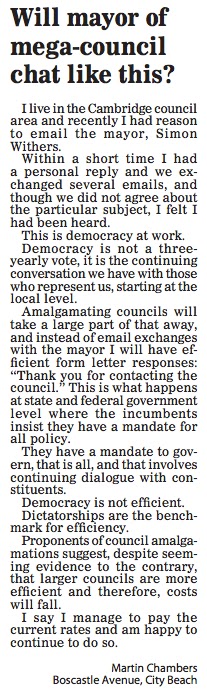
Whether it's Cambridge, Vincent or Subiaco, smaller Councils get the vote from ratepayers on accessibility.

Larger councils like Stirling or Perth (the latter not large in population but large on level of budget and activity) are more often seen as remote and difficult to approach.

Take Council Meetings, for example. At Vincent you can just turn up to the Council meeting and be heard - and not only on matters that are on the agenda that night. At City of Perth, only questions, not comments, can be made, they must relate to an item on the agenda and it is 'preferred' that they be submitted in advance on a standard form. Questions received prior to the meeting are read aloud by the Chief Executive Officer - just to make sure you don't slip in a comment or two or get 'off-topic'.

Now, it's understandable that larger Councils, having more business to deal with, need to be more formalised and restrictive in terms of how residents and ratepayers can approach them, but this does make them less responsive to emerging concerns and individual interests.

Whatever the efficiency arguments - and I have to disagree with Martin Chambers about dictatorships being the benchmark for efficiency (although I suspect he said it tongue-in-cheek) - larger local governments are less good for community democracy. 

On the subject of dictatorships, most of them are in practice highly inefficient - but it goes 'unnoticed' because no one dares speak up. This seems to be the way that Col Pot is taking his forced local government amalgamation agenda, by attempting to remove the requirement for the Local Government Advisory Board to ask for submissions on amalgamation proposals.